

Technology
The stack behind production AI
We're model- and vendor-agnostic. Every engagement uses the tools that best fit the problem — and leaves your team with code they can read, run, and extend.
What we work with
Six pillars of the modern AI stack
LLMs & Agentic Frameworks
OpenAI, Anthropic, Google, and open-weight models orchestrated with LangGraph, LlamaIndex, and custom agent runtimes to fit each problem.
Retrieval & Knowledge
Vector stores (pgvector, Pinecone, Weaviate), hybrid search, and structured retrieval so your agents ground answers in your data — not the open web.
Workflow Orchestration
Durable pipelines with Temporal, Prefect, or n8n; tool-calling agents that safely span APIs, databases, and human approvals.
Governance & Evaluation
Guardrails, tracing (LangSmith, Langfuse), red-teaming, and eval harnesses so behavior is measurable before and after launch.
Cloud & Deployment
AWS, GCP, Azure, and Cloudflare Workers — containerized services, serverless functions, and edge-deployed frontends chosen to match your team's stack.
Product Engineering
TypeScript, React, Python, and FastAPI for user-facing surfaces; PostgreSQL and Supabase for data; clean, documented code your team can own.
The full picture
How the pieces fit together
A production AI system is more than a model. It's a stack of specialized layers plus a set of cross-cutting components that keep the system safe, fast, and observable.
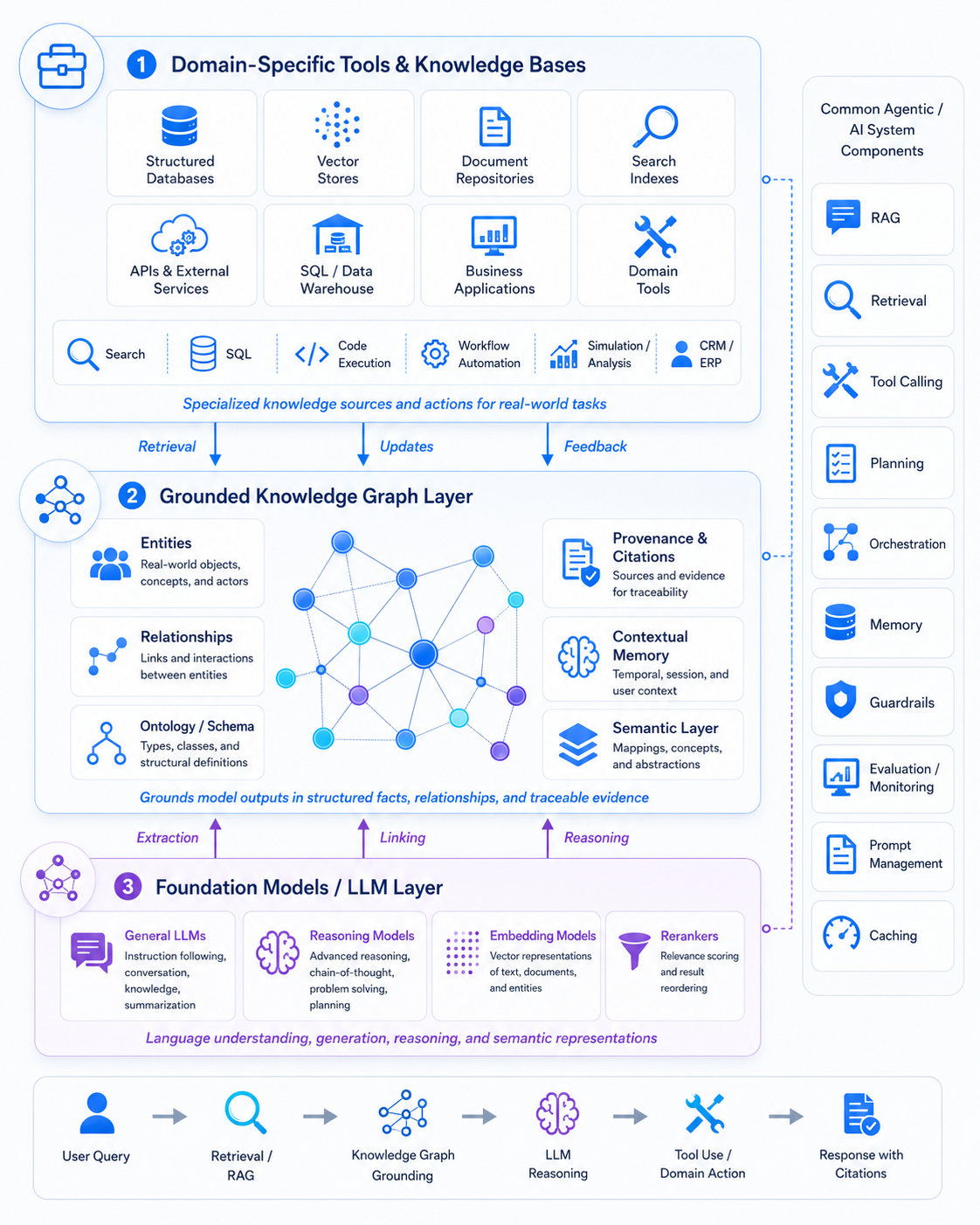
A request, end to end
Cross-cutting components
Common agentic building blocks
RAG
Retrieval-augmented generation pipelines that inject grounded context into every model call.
Retrieval
Hybrid semantic + keyword search across your documents, databases, and APIs.
Tool Calling
Structured function calls that let the model act on systems, not just describe them.
Planning
Multi-step task decomposition so agents can tackle work that spans several actions.
Orchestration
Durable coordination across models, tools, humans, and long-running workflows.
Memory
Short- and long-term memory for sessions, users, and evolving domain knowledge.
Guardrails
Policy, safety, and schema enforcement on inputs and outputs before they reach production.
Evaluation / Monitoring
Traces, evals, and dashboards that keep quality measurable after launch — not just at demo time.
Prompt Management
Versioned prompts and templates you can test, roll back, and improve without redeploying.
Caching
Response, embedding, and retrieval caches that cut latency and cost at scale.
How we choose
Principles that guide the toolkit
Right-sized models
We pick the smallest, cheapest model that solves the job, then scale up only where quality demands it.
Portable by design
No lock-in to a single vendor. Abstractions and infrastructure-as-code make it easy for your team to swap providers later.
Production-first
Observability, testing, and CI/CD are wired in from week one — not bolted on after a prototype ships.
Curious whether your stack fits?
We meet teams where they are — cloud provider, database, or preferred model. Let's talk through what you already have and where AI adds the most leverage.