

How OnTarget is built
This is the technical companion to the OnTarget case study. It describes the system architecture, the integrated data sources, how a question moves through the agent, and how citations stay attached to primary records.
Design Principles
A retrieval-first agent over a growing set of curated data sources.
The implementation rests on four design principles. A researcher states the question; the agent plans a retrieval strategy, executes it against the integrated sources, synthesizes the results, and returns citations that resolve to primary records.
Tool-integrated agents
Secure connectors to dozens of biomedical APIs and internal data sources.
LLM planning & orchestration
Goals are decomposed into multi-step plans the agent executes and validates.
Evidence-grounded outputs
Every claim is linked back to its source — no hallucinated citations.
Governed execution
Human-in-the-loop approval gates for sensitive or irreversible actions.
System Architecture
Three layers, with orchestration and oversight across all of them.
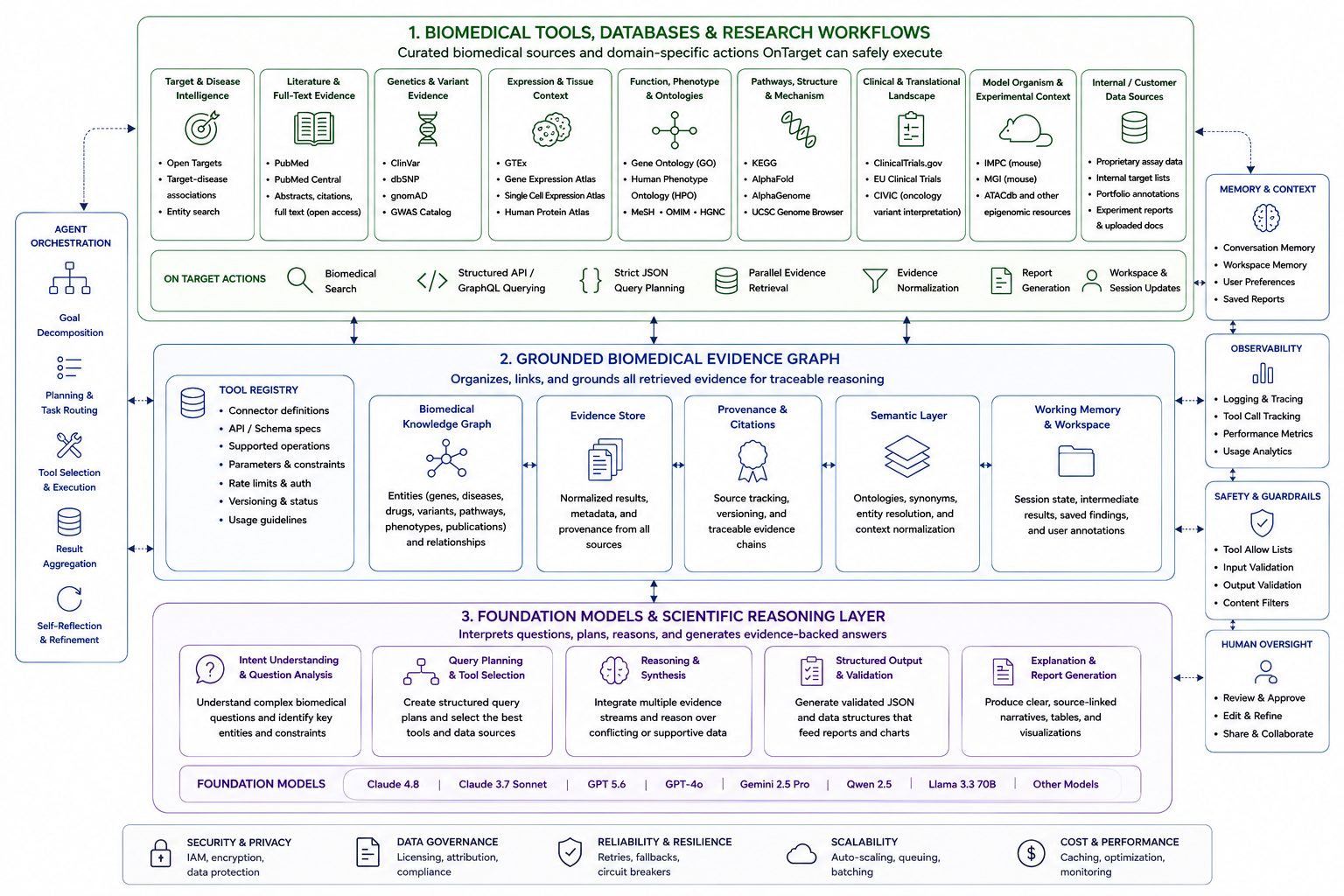
The system is organized in three layers: biomedical tools and data sources at the base, a grounded evidence graph in the middle, and a reasoning layer over foundation models at the top. Orchestration, memory, observability, guardrails, and human oversight span all three.
Although the first workflow is genetics-led, much of the underlying implementation is not specific to genetics. Source integration, entity normalization, retrieval planning, provenance tracking, citation handling and report generation are general components. What remains domain-specific is the choice of evidence, the interpretation applied to it, and the criteria by which it is evaluated.
Integration Coverage
The integrated data sources.
A growing set of public and proprietary databases (seventeen at present) is queried as a single corpus rather than one lookup at a time. The agent selects a query strategy per question, since the informative source differs between, for example, a regulatory-annotation question and a clinical-significance question.
Literature & Evidence
Targets & Disease
Genetics & Variation
Pathways & Function
Expression & Structure
Clinical Landscape
Request Path
How a single question moves through the system.
Each stage produces an inspectable artifact — a retrieval plan, a set of returned records, a reconciled assessment, and a cited output.
Frame the question
A consultant states a gene, variant set, or disease hypothesis in natural language. The agent restates the question as an explicit retrieval plan, which the consultant can inspect before execution.
Retrieve genetic evidence
The plan is executed against the integrated databases: association data, variant records and clinical significance, allele frequencies, expression context, regulatory annotation, and supporting literature.
Reconcile and score
Records that describe the same target are aligned across sources, conflicts are surfaced rather than averaged away, and each target receives a suitability assessment with the evidence that produced it attached.
Report with traceable citations
The synthesis is rendered as a brief or slide narrative in which every assertion carries a numbered citation resolving to the primary record, so a reviewer can verify the chain without re-running the search.
Evidence in Action
A worked example.
The sequence below follows a single question — "Are there CTCF binding sites near the LIN28B gene?" — from the agent's answer, through the primary record supporting it, to the report a consultant delivers.
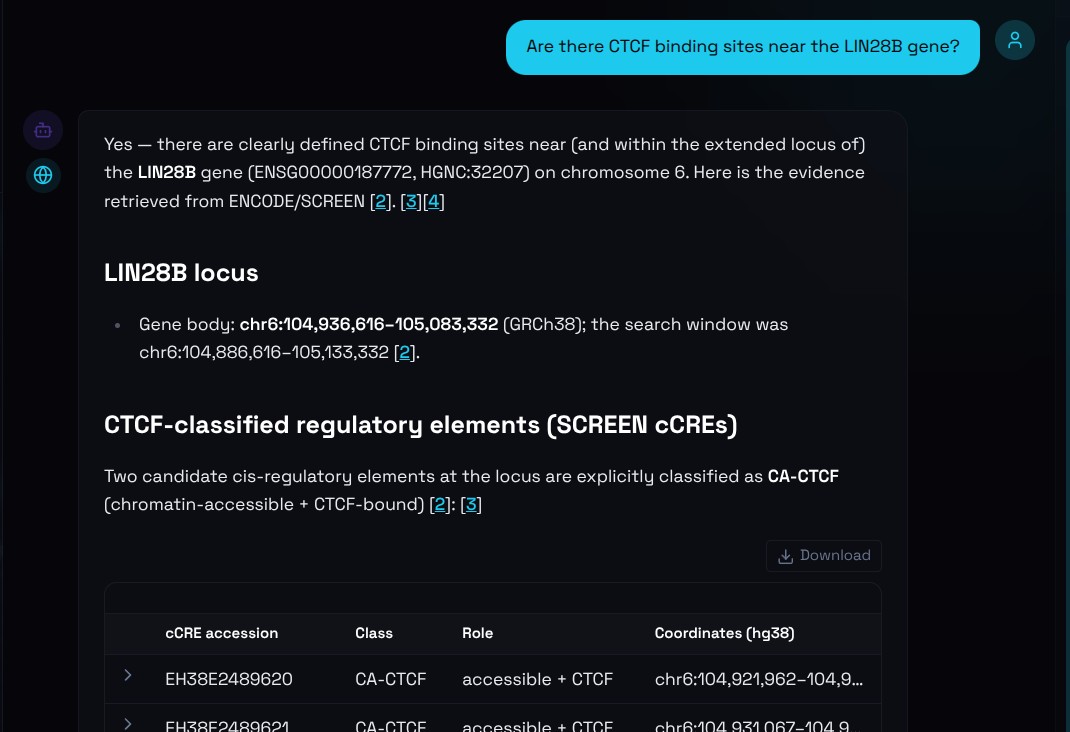
1. The answer, with numbered citations
The response reports genomic coordinates, cCRE accessions, and evidence classes. Each statement carries a reference to the record it came from.
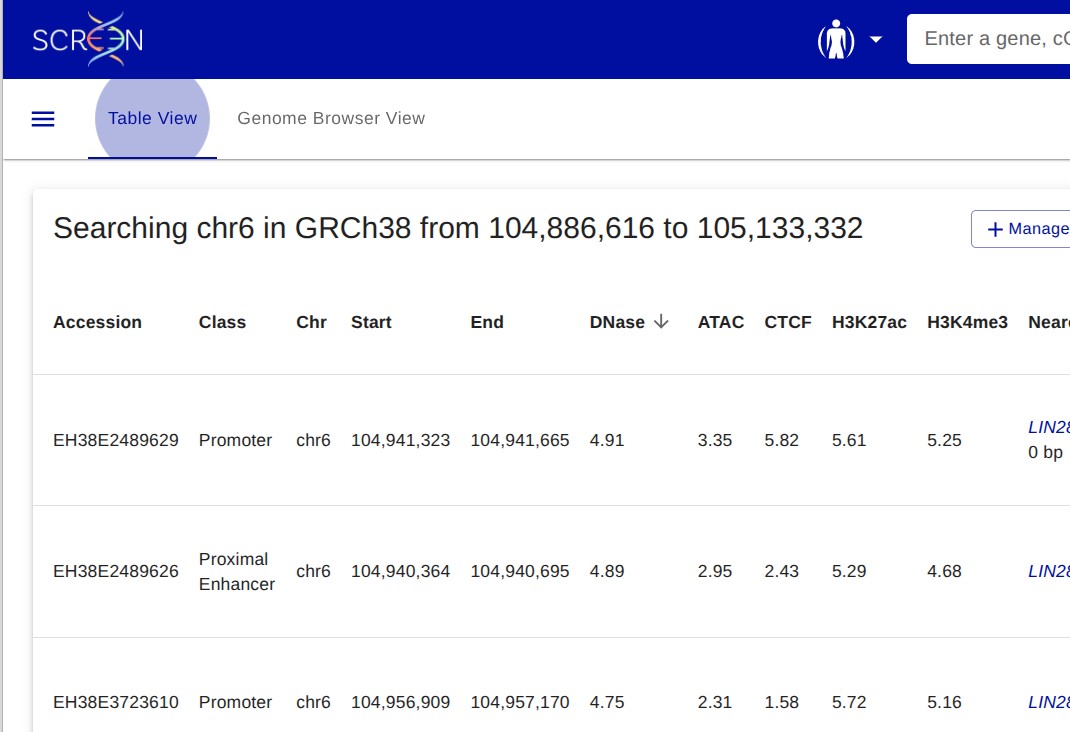
2. The primary record
Each citation resolves to the public database entry — here ENCODE/SCREEN — allowing a reviewer to confirm the underlying data directly.
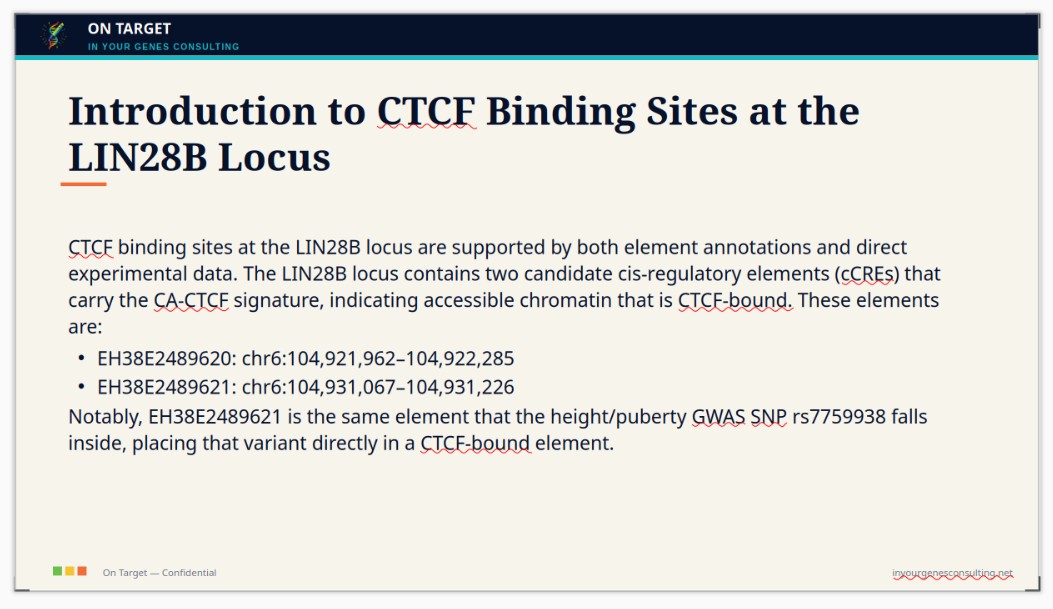
3. The delivered output
The same grounded answer is rendered as a report or slide, retaining its citations and requiring no manual reformatting.
Engineering Notes
Implementation decisions that shaped the system.
Retrieval precedes synthesis
The agent is not permitted to compose an answer and then look for support. Planning, retrieval, and reconciliation are separate stages, and the synthesis stage only sees records that were actually returned.
Per-question query strategy
The informative source differs between, for example, a regulatory-annotation question and a clinical-significance question. The planner selects sources and query shape per question rather than fanning out uniformly.
Citations as data, not prose
Citations are carried as structured references attached to each assertion, so they survive rendering into briefs and slide decks and resolve to the primary database entry.
Conflicts are surfaced
Where sources disagree, the disagreement is reported alongside both records instead of being collapsed into a single averaged score.
Batch execution
The same pipeline runs over hundreds of SNPs in a single workflow run, with per-record provenance preserved throughout.
Residual risk
Complex genetic evidence still carries a residual risk of fabricated or misattributed claims. Citation verification is therefore built into the user workflow as an explicit step rather than treated as an optional review.
Want the same architecture in your domain?
Retrieval-first agents with traceable citations are not specific to genetics.